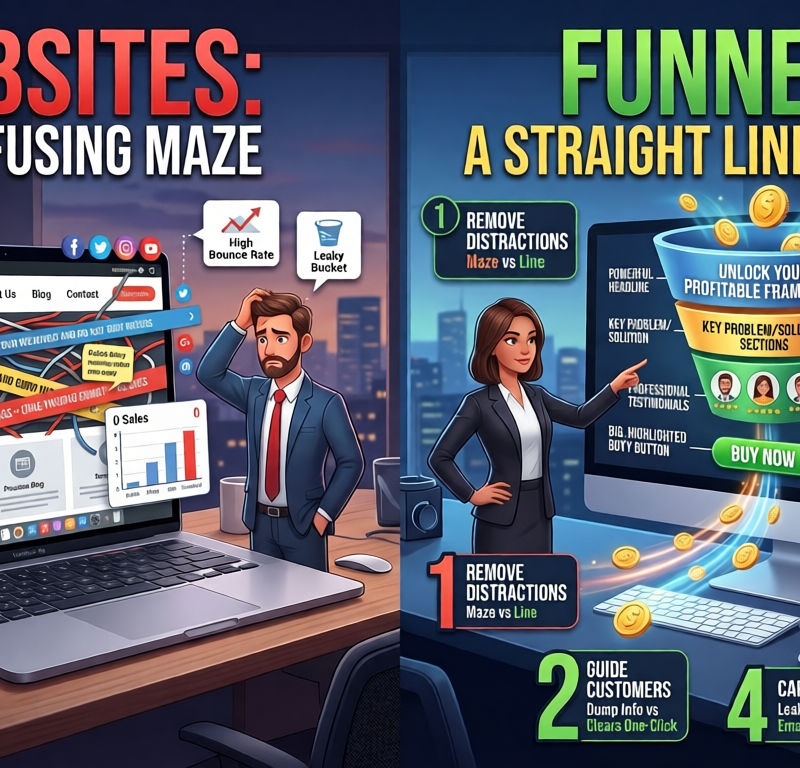
A website is a building with many doors and no guide. A funnel is a hallway with one door at the end and someone walking beside you the whole way.
Both can be beautiful. Only one reliably produces sales.
1. A funnel has one job
Attention → interest → proof → offer → checkout. Every element either advances that sequence or gets deleted. That constraint is why funnels convert several times better than general websites for the same traffic.
2. A funnel captures people who aren't ready
The free asset at the front end means a visitor who won't buy today still becomes a contact you can follow up with for years. Websites let those visitors leave anonymously.
3. A funnel is measurable
Four numbers tell you precisely where money is leaking. On a general website, you get a bounce rate and a shrug.
- Landing page view → opt-in rate.
- Opt-in → sales page view.
- Sales page → checkout start.
- Checkout start → purchase.
4. You can build one this weekend
Lead magnet, landing page, thank-you page with the offer, five-email sequence, checkout. That's it. You don't need forty pages before you're allowed to sell something.
Frequently asked questions
Do I still need a website if I have a funnel?
Yes, for credibility and search traffic — but the site should feed the funnel rather than compete with it. Search brings strangers; the funnel converts them.
What's a good opt-in rate for a lead magnet?
20–40% from targeted traffic is healthy. Below 10% usually means the free asset isn't solving an urgent enough problem.
Turn the reading into action.
Explore practical tools for developing your concept, launching a product and building a business from the ground up.