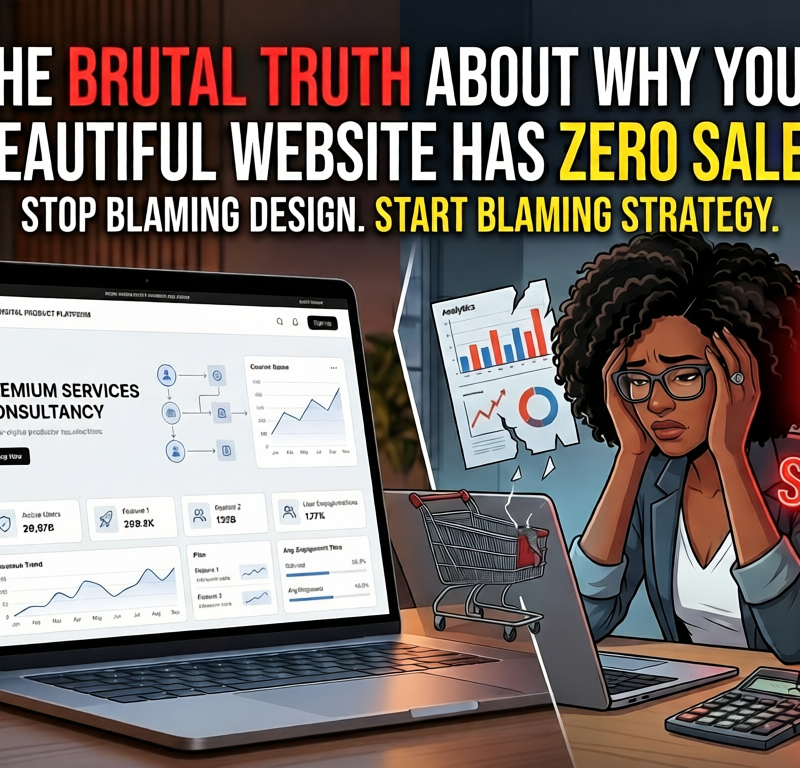
You paid for the design. It animates. It looks like the sites you admire. And it has sold nothing.
A website's job isn't to impress — it's to make a stranger confident enough to hand over money. Those are different jobs.
Nobody can tell what you sell in five seconds
Above the fold you need three things: what it is, who it's for, and what to click. 'Empowering visionary solutions' is not what it is. 'Patent your invention for $60 and launch it' is.
There's no reason to believe you
- Awards, credentials, partnerships and press logos.
- Real customer results with names and specifics.
- Photos of the actual product being used by actual people.
- A clear refund or guarantee statement.
You're asking for the sale once, at the bottom
Buying intent spikes at different moments for different people. Place a call to action after the promise, after the proof, after the pricing and after the FAQ — the same action, repeated, not four competing ones.
The price is hiding
Hidden pricing reads as expensive and evasive. Show the number, then immediately show the value stack next to it so the number looks small.
Checkout is a maze
Every extra field, redirect and surprise fee costs conversions. Name, email, pay — on the same site, on mobile, in under sixty seconds.
Frequently asked questions
What's a good conversion rate for a product website?
For cold traffic, 1–3% is typical; warm traffic from email or a known audience often converts at 5–10%. If you're at zero, the problem is clarity or trust, not fine-tuning.
Should I fix my website or run ads first?
Fix the page. Ads accelerate whatever is already happening, so paying to send traffic to a page that converts nobody just makes you lose money faster.
Turn the reading into action.
Explore practical tools for developing your concept, launching a product and building a business from the ground up.