
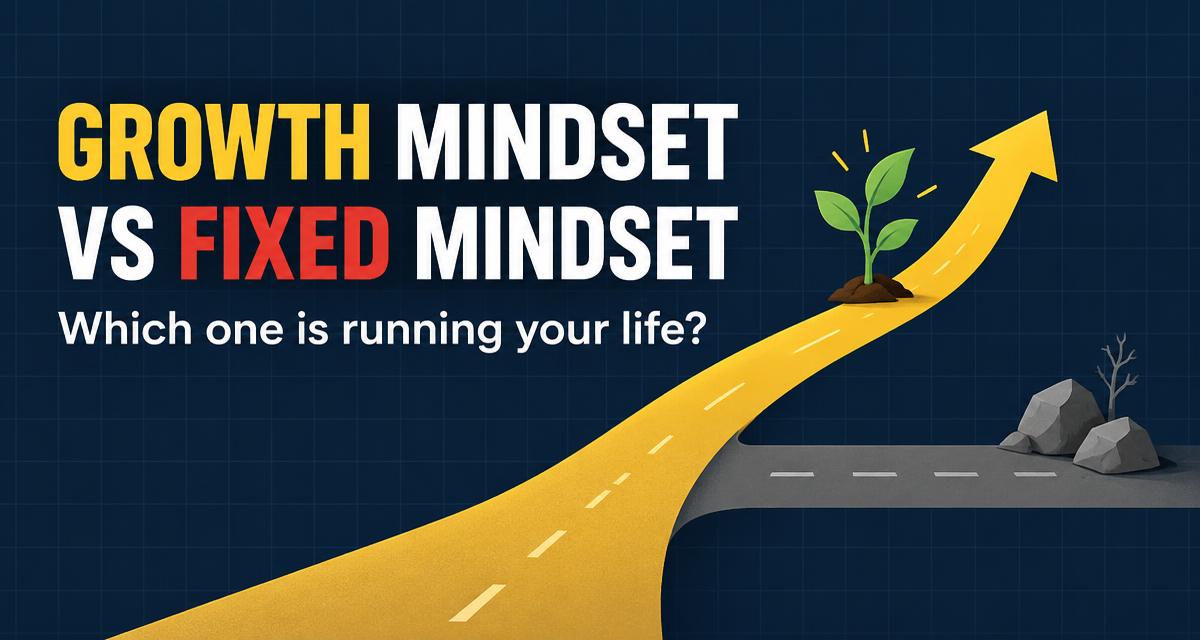
Two people fail at the same thing. One says 'I'm just not good at this' and quits. The other says 'I'm not good at this yet' and tries again. That single word — yet — is the entire difference between a fixed mindset and a growth mindset.
The concept comes from psychologist Carol Dweck's decades of research: people who believe abilities can be developed consistently outperform people who believe abilities are set in stone. The good news is that mindset itself is not fixed. Here is how to spot your fixed-mindset patterns and replace them.
What a fixed mindset actually sounds like
A fixed mindset rarely announces itself. It disguises itself as realism: 'I'm not a math person.' 'I'm too old to start a business.' 'Some people are just naturals.' Each statement sounds like an observation, but it is really a decision — a decision to stop before trying.
The tell is the word 'just' and the word 'can't' without a time limit. Fixed mindset treats current ability as identity. Growth mindset treats current ability as a starting point.
What the research says
Dweck's studies showed that praising effort and strategy ('you worked hard on this') rather than talent ('you're so smart') made people more willing to take on hard problems and more resilient after failure. The brain is plastic — skills physically rewire it through practice.
This matters beyond school. In business, a fixed mindset makes you avoid feedback, hide mistakes and quit at the first 'no'. A growth mindset makes you treat every rejection as data.
Five fixed-mindset traps and their growth-mindset swaps
- 'I failed' → 'I learned what does not work'
- 'I can't do this' → 'I can't do this yet — what's the first small step?'
- 'Feedback is criticism' → 'Feedback is a shortcut I didn't have to pay for'
- 'They're naturally talented' → 'They practised more than I can see'
- 'This is too hard' → 'This is exactly where the growth happens'
How to retrain your brain in daily life
Start with language. For one week, catch every absolute statement about yourself and add 'yet' or rewrite it as a process. It feels mechanical at first; within weeks it becomes automatic.
Then chase small discomforts deliberately. Do one thing each day you are bad at — a new tool, a hard conversation, a skill tutorial. The point is not mastery; it is teaching your brain that struggle is normal and survivable. Keep a simple log of what you attempted and what you learned. Watching the entries pile up is the proof your mindset needs.
The mindset is the foundation, not the finish line
A growth mindset does not guarantee success — it guarantees you stay in the game long enough for skill, strategy and luck to compound. Pair it with clear goals and a system for tracking progress, and you have something far more powerful than motivation: momentum.
Sources and further context
Your next useful read
Frequently asked questions
What is the difference between a growth mindset and a fixed mindset?
A fixed mindset believes abilities and intelligence are static traits. A growth mindset believes they can be developed through effort, strategy and feedback. The difference shows up most clearly after failure: fixed mindset quits, growth mindset adjusts.
Can adults change from a fixed mindset to a growth mindset?
Yes. Mindset is a habit of interpretation, not a personality trait. Catching fixed-mindset self-talk, adding 'yet', and deliberately practising new skills rewires the pattern over weeks of repetition.
Who coined the term growth mindset?
Psychologist Carol Dweck of Stanford University, based on decades of research into motivation and achievement, popularised in her book 'Mindset: The New Psychology of Success'.
Is a growth mindset just positive thinking?
No. Positive thinking says 'everything will be fine'. A growth mindset says 'this is hard, and effort plus strategy will make me better at it'. It is about process, not optimism.
Rebuild your mindset, chapter by chapter
The Inner Architect is our $2.99 e-book on redesigning the beliefs that run your life — the perfect companion to everything in this article.