
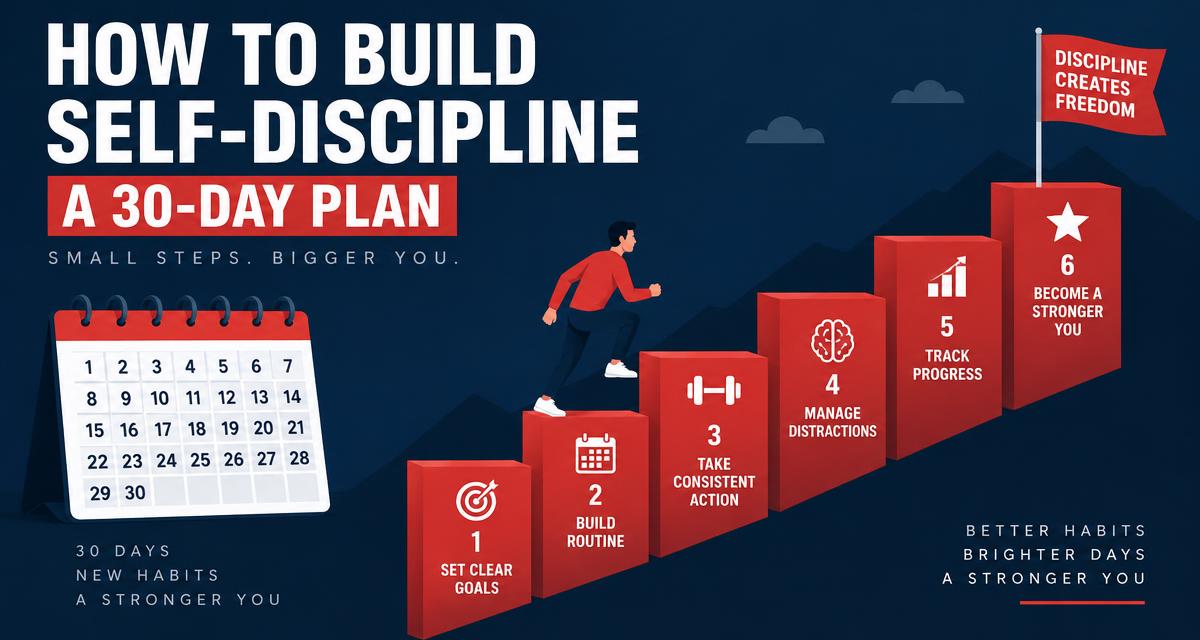
Motivation comes and goes. Discipline is what gets you moving on the days motivation does not show up.
The good news: discipline is a skill, not a personality trait. You build it the same way you build a muscle — small, repeated reps. This 30-day plan shows you exactly how.
Why discipline beats motivation
Motivation is a feeling; discipline is a system. Research on habits shows that repeating a behaviour in the same context makes it more automatic over time — so you need less willpower, not more.
Week 1 (Days 1–7): Set one clear goal
- 1. Choose ONE goal only — e.g. 'Write 300 words a day'.
- 2. Make it specific and measurable.
- 3. Write down why it matters to you.
- 4. Decide the exact time and place you will do it.
Week 2 (Days 8–14): Build the routine
- 1. Attach the new habit to an existing one ('After my morning coffee, I write').
- 2. Keep it small enough to do on your worst day.
- 3. Prepare the night before — clothes out, file open, desk clear.
Week 3 (Days 15–21): Manage distractions and temptations
- 1. Remove triggers: phone away, apps logged out.
- 2. Use 'if–then' plans: 'If I feel like skipping, then I do just 5 minutes.'
- 3. Tell one person about your goal for accountability.
Week 4 (Days 22–30): Track, review and level up
- 1. Mark every completed day on a visible chart.
- 2. Review weekly: what worked, what didn't?
- 3. Increase difficulty by about 10% only after a full week of success.
- 4. Celebrate day 30 — then pick the next habit.
5 mistakes that break discipline
- Starting too many habits at once.
- Setting goals that are too big.
- Relying on motivation.
- Quitting after one missed day (never miss twice instead).
- Not tracking anything.
Sources and further context
Your next useful read
Frequently asked questions
How long does it take to build self-discipline?
A widely cited UCL study found new habits took an average of 66 days to become automatic, ranging from 18 to 254 days. Thirty days is a strong start, not the finish line.
Can you build discipline if you've always been lazy?
Yes. Start with a habit so small it feels silly. Consistency matters far more than size early on.
What if I miss a day?
Missing once barely affects habit formation. The rule is: never miss twice in a row.
Is discipline the same as willpower?
Not quite. Willpower is effort in the moment; discipline is the system — routines, environment and tracking — that reduces how much willpower you need.
Your 30 days, on one page
The Daily Momentum Cheat Chart gives you a printable tracker for every day of this plan.