
Procrastination is not laziness. Researchers describe it as a way of avoiding uncomfortable feelings — boredom, fear of doing it badly, or not knowing where to start.
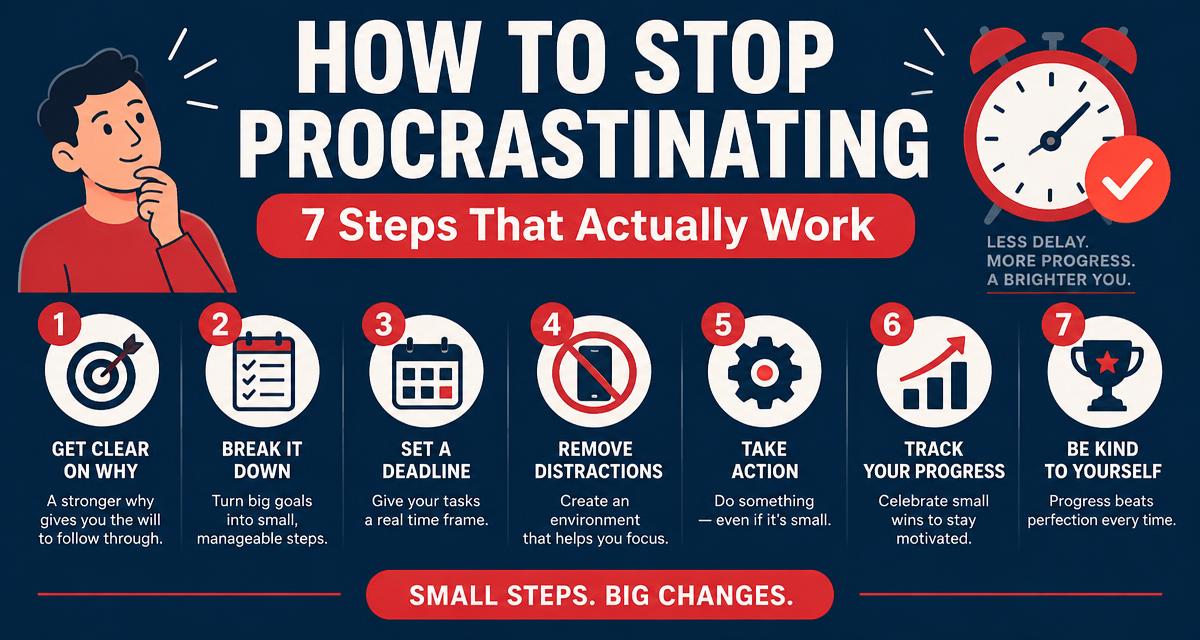
That is good news: if it is a feelings problem, it can be fixed with small, practical tools. Here are seven steps you can start using today, in order.
1. Get clear on why the task matters
Write one sentence: 'I am doing this because…'. A clear reason makes the discomfort feel worth it. Vague tasks ('work on business') invite delay; meaningful tasks pull you forward.
2. Break it into tiny steps
Big tasks feel threatening. Split them until the first step takes less than 10 minutes.
- Bad: 'Write my ebook.'
- Better: 'Write chapter 1.'
- Best: 'Write 3 bullet points for chapter 1.'
3. Use the 2-minute rule
If something takes under two minutes, do it now. For bigger tasks, commit to just two minutes. Starting is the hardest part — once you begin, you usually keep going.
4. Set a real deadline and time block it
Put the task on your calendar with a start and end time. A task with a time slot is a plan; a task without one is a wish.
5. Remove distractions before you start
- Put your phone in another room or turn on Focus mode.
- Close every browser tab you do not need.
- Work in 25-minute sprints with 5-minute breaks (the Pomodoro method).
6. Track your progress visibly
Tick a box every day you show up. Seeing a streak builds momentum and makes skipping feel costly. A simple printable tracker works better than another app.
7. Be kind to yourself when you slip
Studies link self-forgiveness after procrastinating with less procrastination later. Beating yourself up adds the very bad feelings you were avoiding. Reset and do the next tiny step.
Quick summary
- Know your why.
- Shrink the first step.
- Start for two minutes.
- Schedule it.
- Kill distractions.
- Track streaks.
- Forgive and restart.
Sources and further context
Your next useful read
Frequently asked questions
Why do I procrastinate even when I want to do something?
Usually because the task triggers a negative feeling — uncertainty, boredom or fear of failure. Making the first step tiny and clear removes most of that feeling.
What is the fastest way to stop procrastinating right now?
Pick the task, set a timer for two minutes and start the smallest possible step. Momentum usually carries you further.
Does the Pomodoro technique really work?
For many people, yes. Short, timed sprints make work feel manageable and built-in breaks reduce fatigue.
Is procrastination a sign of ADHD?
Not by itself — everyone procrastinates. If it seriously affects work, school or relationships over a long time, talk to a doctor.
Make progress visible
The Productivity Tracker Cheat Chart turns these 7 steps into a one-page daily system you can print and tick off.