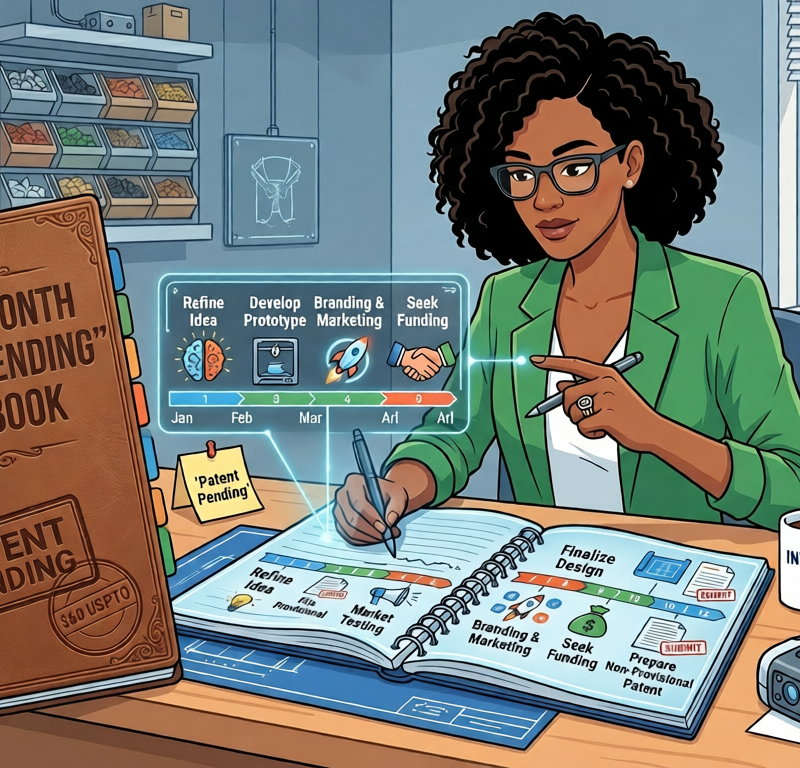
Every week someone messages me with the same sentence: "I have an idea, how do I patent it before someone steals it?" The honest answer is that you can start protecting it this weekend for about $60 — and most of the people charging you thousands are selling you fear, not protection.
I've been through the whole cycle twice: Silver at INPEX 2006 for SofTToss Golf, Gold at INPEX 2017 for TeeterToss and RingSwing, then a national distribution deal with Gopher Sports. Here's the process the way I'd explain it to a friend across a kitchen table.
First: you can't patent an idea — you patent an invention
This is the part nobody says out loud. The US Patent and Trademark Office does not protect thoughts, concepts or "a business like Uber but for X". It protects a specific, described, enabled invention — something a person skilled in your field could actually build from your description.
So step one isn't legal. It's descriptive. Write down exactly what the thing is, what problem it solves, how it's built, what materials it uses, how it works, and every variation you can imagine. Sketch it from three angles. Photograph the prototype, even a cardboard one.
Step 2: document and date everything before you show anyone
The United States runs on first-to-file, not first-to-invent — so documentation doesn't beat a filing. But documentation is what keeps you honest about dates, and it's what you'll lean on if a conversation goes wrong before you file.
- Keep a dated inventor's notebook — write in pen, number the pages, never tear one out.
- Have key pages notarized. It's cheap and it creates a third-party dated record.
- Email yourself the files, or mail yourself a sealed copy. Not legal proof of ownership, but useful corroboration.
- Use a simple mutual NDA before you show a manufacturer, engineer or potential partner.
Step 3: run your own prior art search (free)
Before you spend a cent, search Google Patents, the USPTO full-text search and plain Google Shopping. Search the function, not your product name — "tilting balance ball toss game", not "TeeterToss".
You're looking for two things: whether your exact invention already exists, and how existing patents word their claims. Reading twenty patents in your category will teach you more about claim language than any course.
Step 4: file a provisional patent application (~$60 for micro entities)
A provisional patent application (PPA) is the single best value in the entire invention world. As of 2026, a micro-entity filing fee sits around $60–$65, and you file it yourself through USPTO Patent Center.
What it buys you: 12 months of legal "Patent Pending" status and a priority date. During those 12 months you can talk to manufacturers, pitch retailers, run a Kickstarter, and post it publicly — with your date locked in.
- Create a USPTO.gov account and verify your identity.
- Certify micro-entity status if your income and prior filings qualify (form SB/15A).
- Upload your written description, drawings and the cover sheet as PDFs.
- Pay the fee, save the confirmation and application number. That number is your patent pending.
Step 5: use the 12 months — that's the whole point
The provisional expires. If you do nothing, your priority date evaporates and your public disclosures can be used against you. So treat the 12 months as a business sprint, not a waiting room.
Tool a real sample. Get pricing from at least three factories. Sell some units. Approach distributors. Then decide with real evidence whether the invention deserves the $1,500–$10,000 that a non-provisional utility patent will cost you.
What it actually costs
- Provisional patent (micro entity, self-filed): ~$60
- Design patent (self-filed, micro entity): a few hundred dollars in fees
- Non-provisional utility patent, self-filed: roughly $400–$800 in USPTO fees
- Non-provisional with an attorney: $5,000–$15,000+ depending on complexity
- Not filing at all, then watching a competitor file: the expensive one
Frequently asked questions
How much does it cost to patent an idea?
You can get patent-pending status for about $60 by filing a provisional patent application yourself as a micro entity. A full non-provisional utility patent costs roughly $400–$800 in USPTO fees if you file it yourself, or $5,000–$15,000 with an attorney.
Can I patent an idea for free?
No — the USPTO always charges a filing fee, and the cheapest legitimate route is the micro-entity provisional at around $60. What is free is the preparation: documentation, prior art searching, drawings and NDAs.
How long does patent pending last?
A provisional patent application gives you 12 months of patent-pending status. To keep the priority date you must file a non-provisional application before that year runs out.
Turn the reading into action.
Explore practical tools for developing your concept, launching a product and building a business from the ground up.