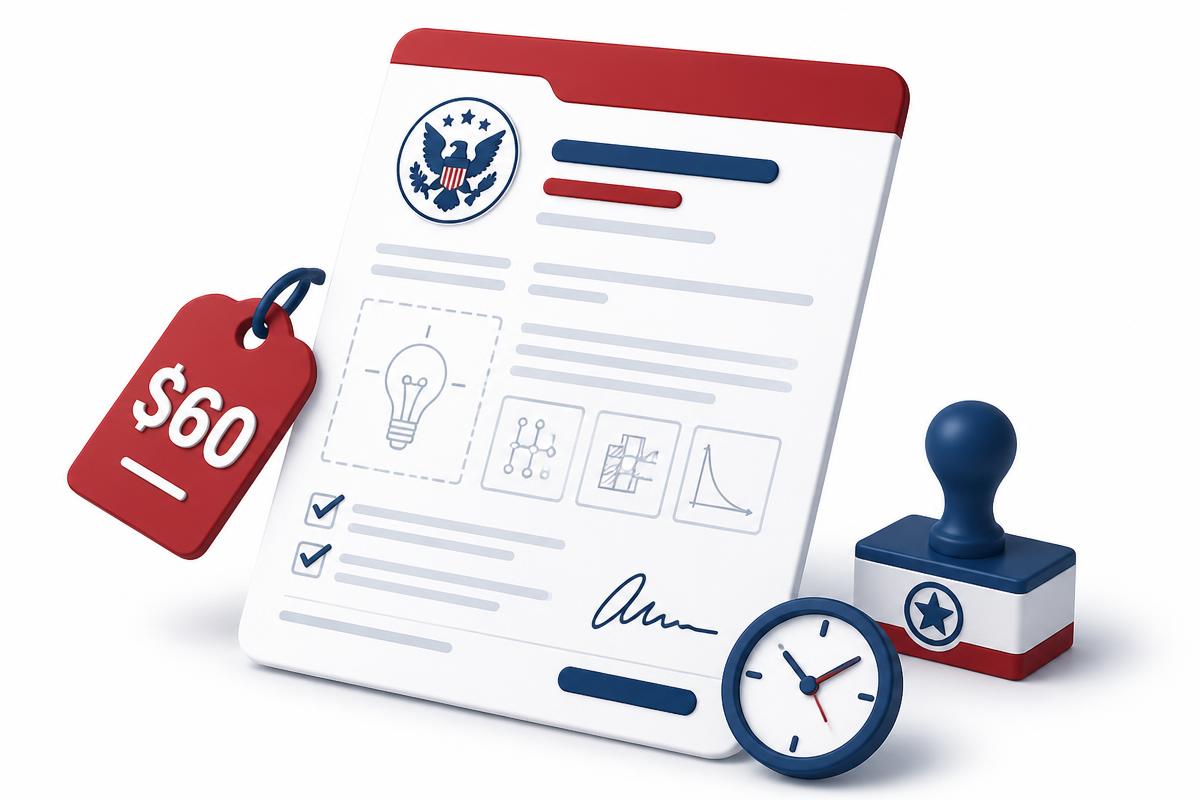
The provisional patent application is the cheapest serious move an inventor can make. Sixty dollars and an afternoon buys you a full year of legally usable "Patent Pending" status — the same status printed on products sitting in national retail.
Most people never file because the process looks intimidating from the outside. It isn't. Here's the whole thing, start to finish.
Do you qualify as a micro entity?
Micro-entity status is what drops the fee to around $60. You generally qualify if you have been named on fewer than five previously filed non-provisional US applications, your gross income last year was below roughly three times the median household income, and you haven't assigned rights to an entity that exceeds that limit.
If you don't qualify as micro, you file as small entity — still affordable, roughly double. You certify status with form SB/15A during filing.
What goes inside the application
There's no claim requirement in a provisional, and that trips people up. It means you can write in plain language — but it also means the description must be complete. Anything you leave out is not protected. Describe every variation, material, dimension range and alternative use you can think of.
- Cover sheet (form SB/16) with inventor names, title and correspondence address.
- A written specification: field of the invention, background, summary, detailed description, and how to make and use it.
- Drawings — hand sketches are legally acceptable if they're clear and labelled with reference numbers.
- Micro-entity certification (SB/15A) if you're claiming the reduced fee.
Filing in Patent Center, step by step
The receipt contains your application number and official filing date. From that second, you are legally patent pending and may mark your product, packaging and pitch decks accordingly.
- Create a USPTO.gov account and complete identity verification (do this first — it can take a couple of days).
- Open Patent Center and choose 'New submission' → 'Utility' → 'Provisional'.
- Enter inventor and application details, then upload your PDFs and tag each document type.
- Review the fee calculation and select micro entity.
- Pay by card and download the electronic acknowledgement receipt.
Five mistakes that quietly destroy a provisional
- Writing a vague, marketing-style description instead of an enabling technical one.
- Filing after you've already publicly sold or displayed it for more than a year.
- Forgetting the drawings, or drawing only one configuration.
- Assuming the provisional renews. It never does — 12 months and it's gone.
- Changing the invention significantly after filing and not filing an updated provisional.
After you file: the 12-month plan
Month 1–3: prototype and source. Month 4–6: get quotes, refine tooling, test with real users. Month 7–9: pitch buyers, distributors and licensees while showing patent-pending status. Month 10–12: decide — non-provisional, license, or let it lapse because the market told you the truth.
That decision, backed by real market feedback instead of hope, is worth more than the patent itself.
Frequently asked questions
Is a provisional patent legally binding protection?
It establishes a priority date and grants patent-pending status, but it is not an enforceable patent on its own. You cannot sue an infringer on a provisional — you must convert to a non-provisional within 12 months.
Do I need a lawyer to file a provisional patent?
No. Provisional applications are designed to be filed by individual inventors and require no formal claims. Careful, complete writing matters far more than legal formatting.
Can I sell my product while patent pending?
Yes. Selling, pitching and publicly showing your product during the 12-month window is exactly what the provisional is for.
Turn the reading into action.
Explore practical tools for developing your concept, launching a product and building a business from the ground up.