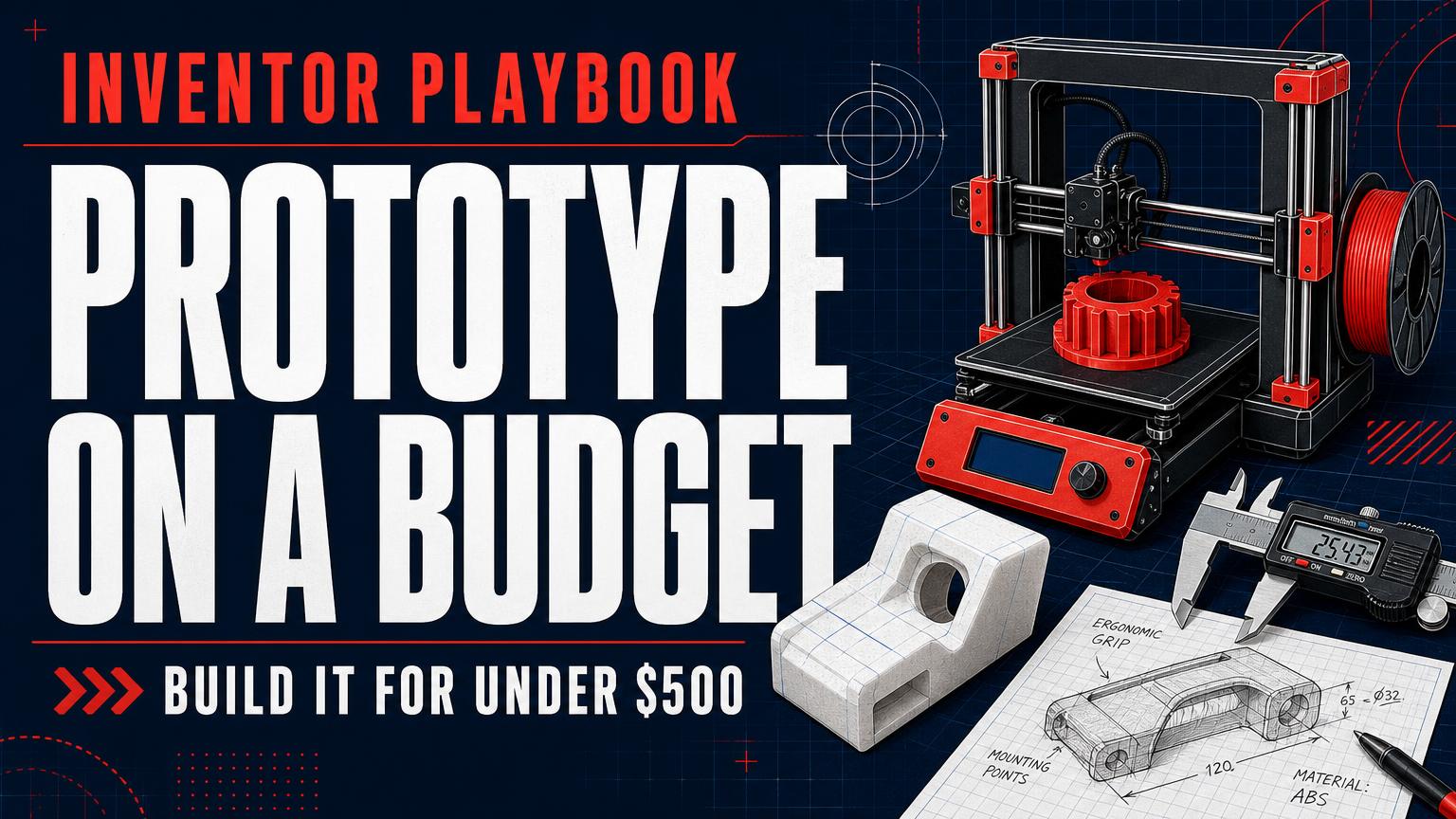
The first prototype of Teeter Toss cost me almost nothing. Foam, PVC, zip ties and an afternoon. The version that went into national distribution through Gopher Sports came years later — and it only existed because the ugly one proved the game was fun.
Most inventors get this backwards. They save for a $6,000 engineered prototype before anyone has ever held the thing. Here is the cheap path that actually works.
The four prototype stages (do them in order)
- Stage 1 — the sketch model: cardboard, foam, tape. Cost: near zero. Purpose: does the geometry work at all?
- Stage 2 — the works-like model: hardware-store parts. Cost: $20–$100. Purpose: does the mechanism function under real use?
- Stage 3 — the looks-like model: 3D print or hand-finished. Cost: $50–$300. Purpose: photos, video, sell sheets, buyer meetings.
- Stage 4 — the production sample: from an actual factory. Cost: $150–$500 for most simple products. Purpose: quoting, tooling and retail conversations.
- Never skip to stage 4. Every skipped stage gets paid for later in tooling changes.
Where the money actually goes wrong
Inventors overspend in three predictable places: hiring an engineer before the concept is settled, tooling a mold for a design that still changes, and ordering inventory to get a lower unit price on a product with zero proven demand.
A prototype is a question, not a product. Spend the smallest amount that answers the question in front of you, then move to the next question.
Cheap ways to get a real prototype made
- Local library or college makerspace — many have free or $10/hour 3D printers and laser cutters.
- Online print services (Craftcloud, JLC3DP, Shapeways) — a palm-sized part is often $15–$40.
- Fiverr or Upwork CAD freelancers — $75–$250 for a clean printable model from your sketch.
- Alibaba sample orders — many factories will make one sample for $80–$300, refundable against a first order.
- Repurpose existing products: cut, combine and modify off-the-shelf items to prove the function before making anything custom.
Protect it before you show it
File a provisional patent before you send drawings to a freelancer, a factory or a buyer. It is around $60–$130 for a micro entity and it gives you twelve months of patent-pending status while you test.
Use a short NDA with domestic contractors. Understand that NDAs with overseas factories are weak in practice, so send only what a supplier needs to quote and hold back the part that makes it special where you can.
What a good budget prototype has to do
- Photograph well from three angles for your sell sheet.
- Survive a 60-second demo video without falling apart.
- Be safe enough to hand to a stranger to try.
- Show the one feature that makes it different — everything else can be crude.
The order I would spend $500 in today
$0 on cardboard and foam this week. $60 on a provisional patent once the concept holds. $120 on a CAD freelancer. $80 on a 3D print. $150 on a factory sample and a decent photo shoot with your phone and a white sheet. That is a package you can put in front of a retail buyer.
Do it in that order and the worst-case outcome is a few hundred dollars and a sharper idea — not a garage full of unsellable inventory.
Frequently asked questions
Do I need a patent before making a prototype?
Not for private sketch models you build yourself. File a provisional before you share drawings with contractors or factories, or publicly demo the invention.
Should I use 3D printing or handmade parts?
Handmade first, printed second. Cardboard and hardware-store parts answer the 'does it work' question for almost nothing; print once the geometry has stopped changing.
How much should a first prototype cost?
Under $500 for the vast majority of consumer products. If a quote comes back in the thousands you are almost certainly buying a later-stage prototype than you need right now.
Can a factory build my prototype for me?
Yes — many overseas factories make samples for $80–$300, but only send them a design that is already settled. Every revision costs you weeks in shipping and a new sample fee.
Turn the reading into action.
Explore practical tools for developing your concept, launching a product and building a business from the ground up.