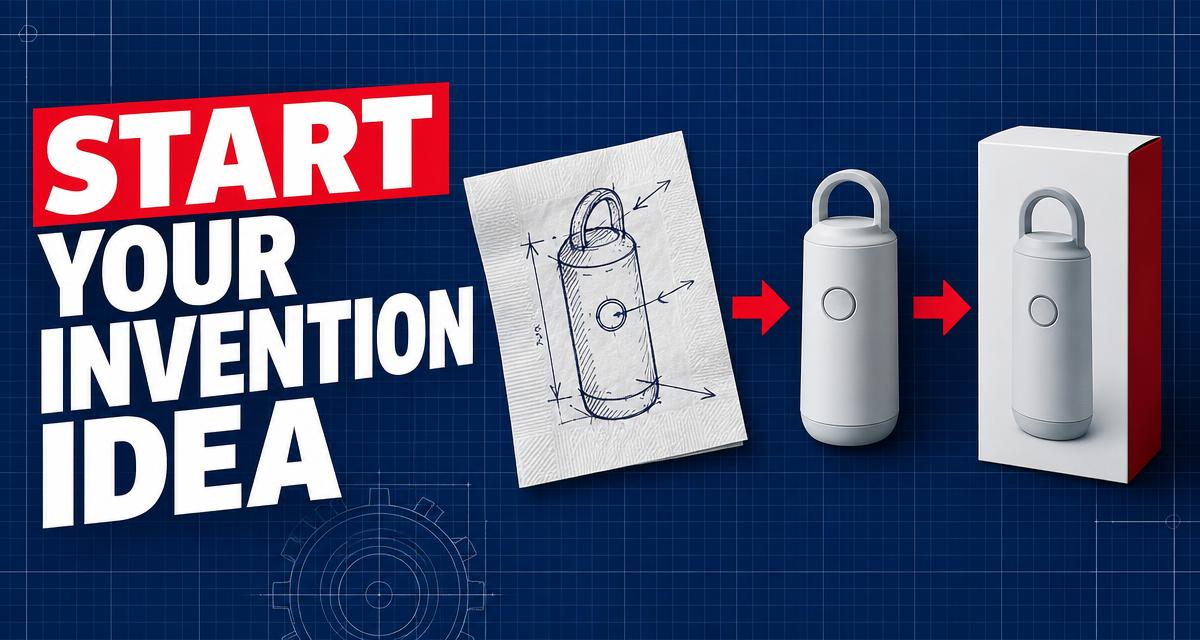
Having an invention idea is exciting and paralyzing at the same time. Most people do nothing — not because the idea is bad, but because nobody ever showed them the order of operations.
These are the first five steps, in the order that protects you and saves money. Do them in sequence and you will know within weeks whether your idea deserves more investment.
Step 1: Write it down properly
Document the idea in detail: what it does, the problem it solves, how it works, and every variation you can imagine. Date it, sign it, and keep it somewhere safe. This record matters later for protection and for your own clarity.
Write the one-sentence version too: 'It's a [thing] that helps [who] solve [problem] by [how].' If you cannot write that sentence yet, the idea needs more thinking before any spending.
Step 2: Search what already exists
Spend a weekend searching: Google, Amazon, patent databases. You are looking for three outcomes — it exists and sells well (study why), it exists and flopped (study why), or it does not exist (find out whether anyone tried).
Finding a similar product is not the end. Most successful products improve on something that exists. What kills ideas is not competition — it is discovering the market does not care.
Step 4: Build the cheapest possible test
You do not need a factory prototype. Cardboard, 3D prints, modified existing products or even a good render can answer the only question that matters: does it work the way you imagine, and do people react the way you hope?
Show the mock-up to ten people in your target buyer group. Ignore polite praise; watch for pull — questions about price, availability, where to buy.
Step 5: Choose your path — sell or license
Two roads diverge here. Sell it yourself: more control, more margin, more work and capital. License it: a company manufactures and sells, you collect royalties — less risk, less reward.
Both paths are real businesses. The right choice depends on your money, time and appetite for running operations — not on which sounds more glamorous.
Frequently asked questions
I have an invention idea — what should I do first?
Document it in writing with a date, then search whether it already exists. These two steps cost nothing and protect you before you spend a dollar or tell anyone the details.
How much does it cost to start an invention?
The first five steps — documenting, searching, an NDA or provisional patent, and a rough prototype — can be done for a few hundred dollars. Serious money only enters once the idea is tested and protected.
Should I quit my job to work on my invention?
No. The early steps fit into evenings and weekends. Keep your income until the product proves it can replace it — most successful inventors started exactly this way.
How do I know if my idea is worth pursuing?
After searching the market and showing a mock-up to ten target buyers, look for pull: people asking about price or availability. Ten polite 'cool idea' responses mean keep testing; ten 'where do I get one' responses mean keep building.
Get the full roadmap
The Product Launch Planner & Tracker turns these steps into a week-by-week system — validation, protection, prototype and launch on one tracked timeline.