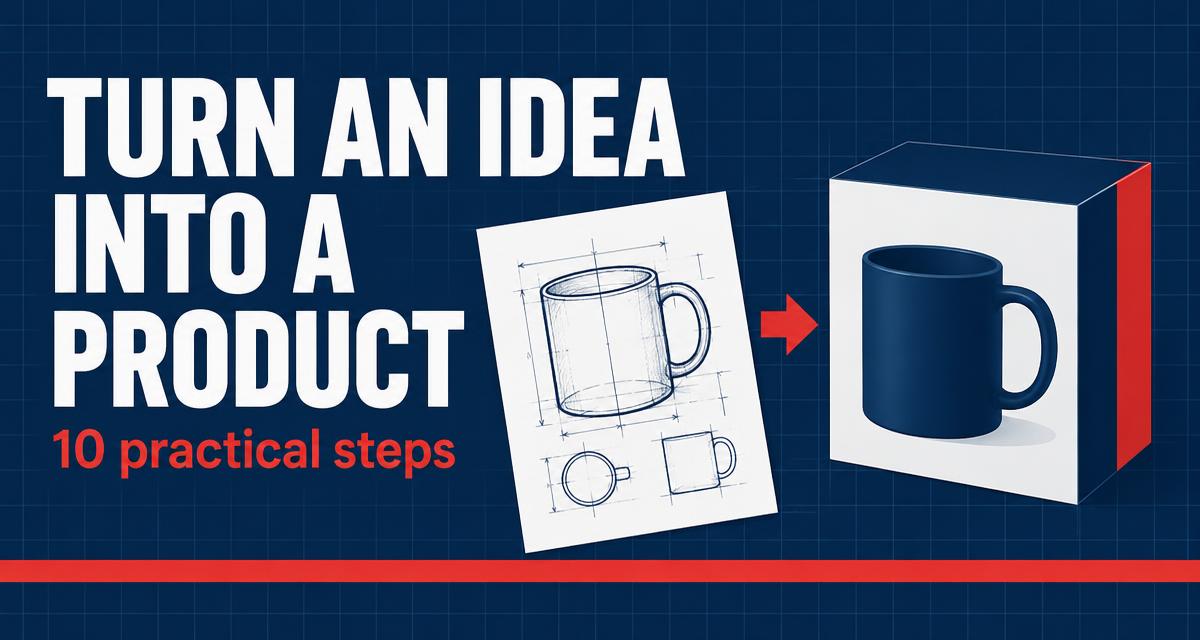
An idea becomes a product the moment someone can buy it, hold it and use it without you explaining anything. Everything between those two points is a sequence, not a mystery.
These are the ten steps in the order they pay off, with the checkpoint that tells you whether to continue or stop.
The ten steps in order
- 1. Write the problem in one sentence, in a customer's words — not the solution.
- 2. Check what already exists: retail listings, marketplace results and granted patents.
- 3. Talk to twenty potential buyers before spending money on anything physical.
- 4. Sketch the product with dimensions; drawings force decisions that words hide.
- 5. Build the cheapest prototype that proves the core function works.
- 6. Cost a single unit at realistic volume, including packaging and shipping.
- 7. File a provisional application if the idea is novel and worth protecting.
- 8. Source two or three manufacturers and quote the same specification to each.
- 9. Package, photograph and price it so retail margin works at every level.
- 10. Launch small, gather reviews, then scale into retail or license it.
The checkpoints that stop expensive mistakes
- After step 3: if fewer than half describe the problem unprompted, change the idea.
- After step 5: if the prototype does not work, no amount of styling will fix it.
- After step 6: if landed unit cost exceeds a quarter of retail price, redesign or reprice.
- After step 8: if two quotes differ by more than 40%, your specification is not clear enough.
- After step 10: if reviews describe a different use, follow the reviews.
Costing before designing
Most first products die on margin, not on the idea. Work backwards: pick the shelf price, divide by four for your target unit cost, then design to it.
Include tooling, packaging, freight, duty, marketplace fees and returns. A product that only works on a spreadsheet without those numbers does not work.
Protect before you show
A provisional application gives you a filing date at a modest cost and lets you talk to manufacturers and buyers with patent pending status.
Where you have no filing, keep disclosure limited and use an NDA with suppliers and partners.
Licence it or sell it yourself?
- Licensing suits inventors who want royalties without inventory or logistics.
- Selling yourself keeps margin but requires cash, storage and customer service.
- Either route needs the same first six steps, so decide after step 6, not before.
- A small self-launch with real sales data makes licensing conversations far easier.
- Whichever route you take, keep the numbers identical across every document.
Frequently asked questions
How long does it take to turn an idea into a product?
For a simple physical product, six to twelve months is typical from sketch to first sale, with sourcing and tooling taking the largest share of that time.
Do I need a patent before manufacturing?
Not always, but filing before disclosing widely protects your date. Many inventors file a provisional application first and decide on a full filing within twelve months.
How much money do I need to start?
A functional prototype and a provisional filing can often be done for a few hundred dollars. The large costs arrive at tooling and the first production run.
What is the most common reason first products fail?
Unit cost. Products designed before the cost target is set usually cannot support retail margin, and retailers will not stock them.
Follow the 10-Step Inventor's Formula
The same ten-step system used to take TeeterToss from a sketch to national distribution, laid out step by step with the checkpoints included.