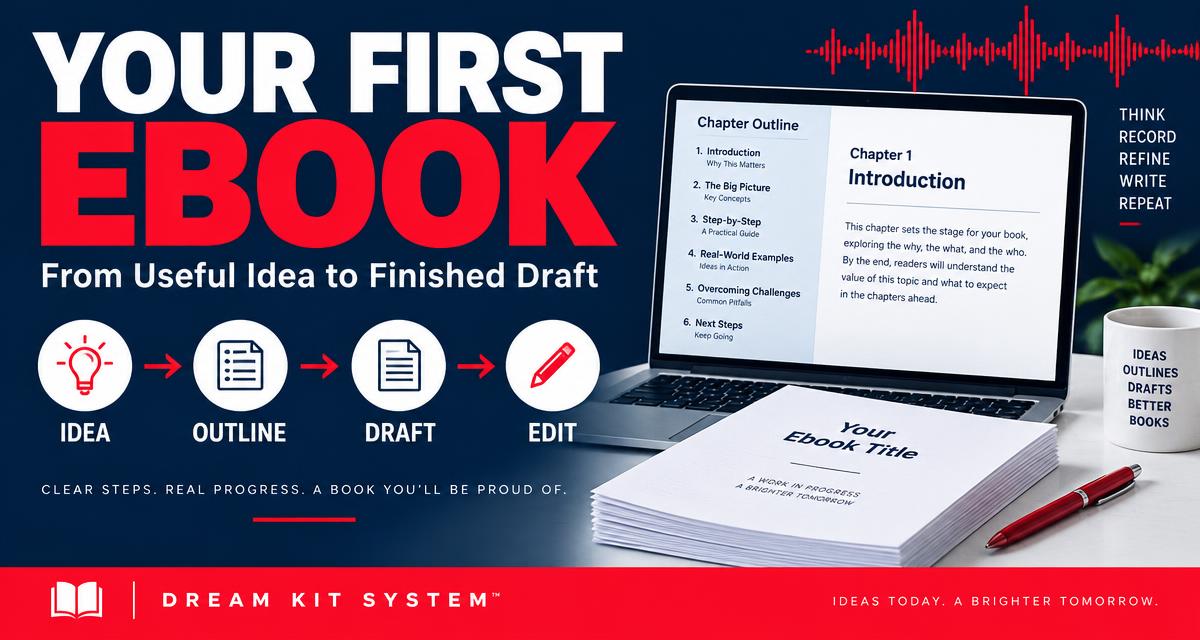
To write an ebook, choose one reader and one useful outcome, build an outline around the steps they need, draft those steps with examples, then edit and test the finished file. Decide where you will distribute it before choosing the final format. A guide needs to work for its reader, not just look good on a product page.
This is a practical first-draft workflow for an original nonfiction guide. It does not promise passive income or sales. Dream Kit System's existing PDF books show one way to distribute digital reading material, but they are not courses in ebook publishing.
Step 1: choose a reader and a narrow promise
Replace 'a book about business' with a task such as 'help a first-time craft seller plan a product photography session.' Write down what the reader already knows, what they need to finish and what is outside your scope. A narrow promise makes it easier to decide what belongs in the book.
Look at questions people ask about the task and speak with potential readers. Demand for a broad topic does not prove demand for your guide. Check existing alternatives and ask what your experience, examples or worksheet would add. Avoid publishing advice you cannot verify, especially financial, legal or health claims.
Step 2: use this ebook outline template
This is a suggested structure, not a required chapter count. For each chapter, write one sentence explaining what the reader can do afterward. If two chapters repeat the same purpose, combine them. If a step needs specialist input, obtain it or clearly leave that area outside the guide.
- Introduction: who this is for, the outcome and important limitations.
- Chapter 1: the problem and the preparation needed.
- Chapter 2: the first action, demonstrated with an example.
- Chapter 3: the next action and common mistakes.
- Chapter 4: a worked example from start to finish.
- Chapter 5: a checklist or worksheet the reader can use.
- Conclusion: the next appropriate step and supporting references.
Step 3: draft the instructions before polishing the introduction
Start with the most useful action chapter. Explain the task, list what is needed, show the action and describe how to check the result. Add a worked example so readers can see the difference between an instruction and an outcome.
Use a consistent vocabulary. If you call a worksheet a 'weekly review' in one chapter, do not rename it a 'progress audit' elsewhere without explaining the connection. Keep source notes while drafting so facts, quotes and borrowed ideas can be checked later.
You can use AI to brainstorm an outline or suggest editing questions, but verify all facts and retain responsibility for the work. Do not copy someone else's book, use unlicensed illustrations or invent testimonials. Check the rules of your chosen publishing platform before submitting AI-generated material.
Step 4: edit by reading and listening
Edit in separate passes: structure first, factual accuracy next, then sentence clarity and formatting. Ask a suitable test reader to attempt the main task without your help. The places they stop are more important than a polite overall rating.
Listening can reveal repeated phrases and awkward sentences. For short passages you are comfortable processing through an online service, use the free ReadAloud reader to hear your draft. Keep confidential material out of online tools unless you have checked the applicable privacy terms. ReadAloud is a text reader, not a professional audiobook production or publishing service.
Check links, chapter order, headings, image permissions and any worksheets. Review a full exported file; a clean draft in your editor does not prove the published file is correct.
Step 5: choose PDF or EPUB for the reading experience
PDF keeps a fixed page layout, which can suit worksheets and printable guides. Check it on a phone because small text and wide pages may be difficult to read. EPUB supports a reflowable reading experience for many text-heavy books. Confirm the accepted formats and layout requirements with the platform you choose.
Amazon KDP's manuscript guidance covers headings, a table of contents, images, hyperlinks and previewing. Its supported-format guidance warns that complex word-processing layouts may not convert as expected. Check the converted ebook with Kindle Previewer rather than assuming your draft's layout survived publication.
Use meaningful headings, readable contrast and descriptions for important images where your format supports them. Test navigation and the table of contents in the actual reading app or device, not just your design software.
Step 6: prepare a clear, honest launch page
A first launch is a chance to learn which readers find the offer useful. Track product-page visits, checkout starts and purchases separately; none means the same thing as the others. If people stop before buying, check unclear expectations and delivery questions instead of assuming the book needs more pages.
For an example of a PDF product offer, explore The Inner Architect. Its subject is mindset, identity and long-term vision; it is not an ebook-writing manual. If your own guide needs a launch schedule, organize the work using a simple timeline before adding more tools.
- Show the title, intended reader and specific outcome.
- State the format, what is included and how access is delivered.
- Provide a representative sample or table of contents.
- Explain any limits, required tools and relevant refund terms.
- Make the price and purchase button easy to find.
- Offer an appropriate way to ask a question before buying.
Sources and further context
Your next useful read
Frequently asked questions
How do I start writing an ebook?
Define one reader and one useful outcome, then outline the steps the reader needs. Draft the main action chapter first and test the instructions with a suitable reader before designing the cover.
How long should an ebook be?
There is no universal ideal length. Include enough explanation, examples and checks to deliver the stated outcome without repeating material or adding unrelated chapters.
Is PDF or EPUB better for an ebook?
PDF can suit fixed-layout worksheets and printable guides. EPUB can suit reflowable, text-heavy reading. Choose based on the reader's needs and the distribution platform's current requirements.
Can I listen to my ebook draft for free?
You can use ReadAloud to listen to text passages while editing. Avoid entering confidential material without checking privacy terms. This editing use is different from producing a professionally narrated audiobook.
Will writing an ebook guarantee income?
No. Sales depend on relevance, quality, trust, distribution and demand. Validate the reader problem and describe the offer honestly rather than relying on passive-income promises.
Explore a real PDF ebook offer
See The Inner Architect's product details for an example of how a digital book is presented. The book covers mindset and long-term vision, not ebook publishing.