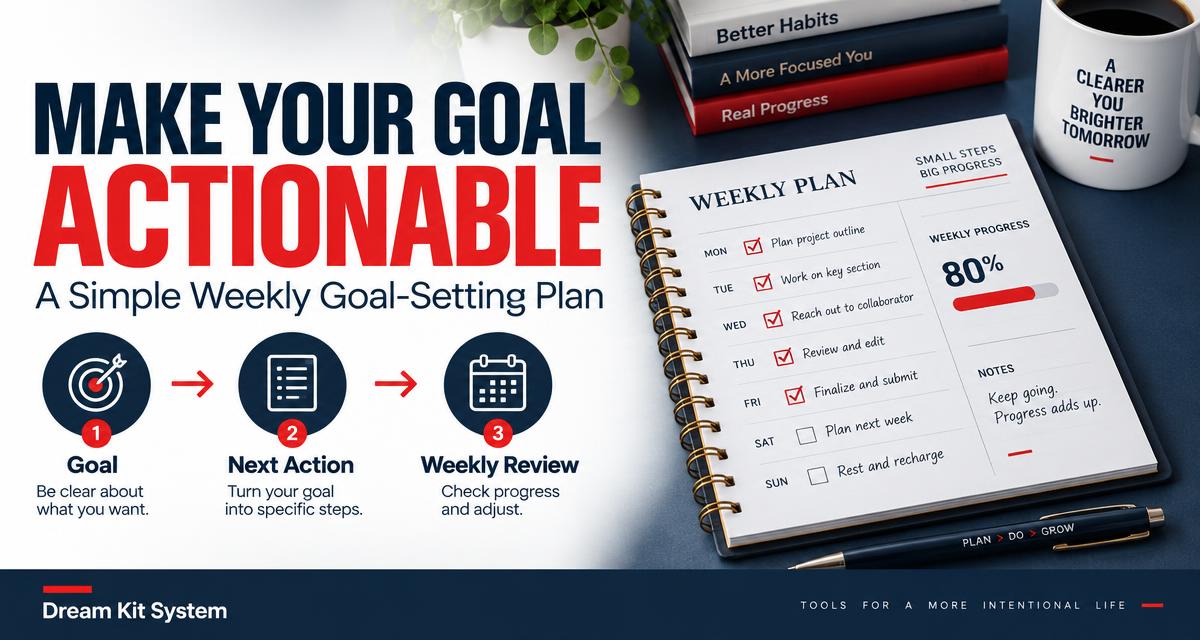
To make a goal actionable, define the outcome, choose a behavior you control, schedule the next step and review the evidence each week. An ambition such as 'launch my business' becomes more useful when it leads to a specific action such as 'interview one potential customer on Tuesday.' Planning supports action; it does not guarantee the result.
This guide combines a practical worksheet with examples for people building a business alongside other commitments. It is general planning guidance, not mental-health treatment or a promise that every goal is attainable.
Step 1: separate the outcome from the action
An outcome is what you want to happen: finish a guide, attract a first customer or build a product test. An action is something you can do: draft a chapter, speak with a potential buyer or compare materials. You control the action more directly than another person's decision.
Write both. For example: 'I want to prepare a useful first guide; this week I will outline the reader's task and draft one worked example.' That statement avoids treating an uncertain sales target as if effort alone could ensure it.
Step 2: choose a meaningful, measurable milestone
Define what finished means. 'Improve my website' is vague; 'check the product description, sample and checkout link on a phone' gives you observable work. Pick a milestone that serves the goal rather than a number that only looks impressive.
Include a review date and a realistic time allowance. Consider your job, family responsibilities and existing deadlines. If the action cannot fit, reduce its scope or move the date instead of assuming a planner can create extra hours.
Step 3: make an if-then plan for the next action
An if-then plan links a recognizable situation to a response. For example: 'If I finish dinner on Tuesday, then I will spend 20 minutes drafting the first worksheet.' The cue should be specific enough to notice and the response small enough to start.
Add a fallback: 'If Tuesday's session is interrupted, then I will draft the worksheet during Wednesday's scheduled lunch break.' This is not a reason to work through every rest period; choose a fallback compatible with your actual needs.
Planning approaches such as these are discussed in goal-setting research. Results vary with the task and circumstances, so treat the technique as a tool to test rather than a guaranteed productivity fix.
Step 4: use this weekly goal-setting worksheet
Copy the fields into a notebook before buying anything. A completed small experiment is often more useful than a perfect layout. If you prefer a prepared printable, the Life Design Cheat Chart includes a 90-day outcome grid, a weekly rhythm chart and a monthly re-score page.
- Goal: what outcome matters and why?
- Milestone: what would count as useful progress this week?
- Next action: what will you physically do first?
- Time and cue: when and where will you begin?
- Obstacle: what is likely to interrupt the action?
- Fallback: what smaller or rescheduled action is realistic?
- Evidence: what completed output will you record?
- Review: what will you keep, change or stop next week?
Step 5: review progress without turning a missed task into a verdict
At the review, compare your planned action with what happened. Was the task unclear, the time unrealistic or the next step dependent on someone else? Diagnose the obstacle rather than using one missed task as a judgment about your ability.
For a product launch, a useful weekly review might record two completed interviews, one unanswered invitation and a revised customer assumption. That is better evidence than 'felt busy.' If interviews show the original problem is not important, changing the goal may be the sensible result.
Keep the review short enough to repeat. Choose one adjustment for the following week and remove tasks that no longer serve the milestone. More tracking is not always better tracking.
Example: turn a business idea into this week's work
Broad ambition: 'I want to turn my concept into a business.' Weekly milestone: 'Understand how one customer group currently solves the problem.' Next action: write five interview questions and send one appropriate invitation.
Scheduled cue: after the planned Wednesday work session starts, open the question document and revise it for 15 minutes. Evidence: a question list and a recorded response to the invitation. Review: identify what you learned and whether the next task is another conversation or a small product test.
This example measures work and learning, not guaranteed sales. Use a goal-setting chart to make decisions visible, then let evidence influence the next step.
Sources and further context
Your next useful read
Frequently asked questions
What is the simplest way to set goals and achieve them?
Define a useful outcome, select one action you control, schedule it and review completed evidence each week. Adjust the plan when time limits or new information change what is realistic.
What is an if-then plan?
An if-then plan connects a specific cue with an action, such as 'If I finish dinner on Tuesday, then I will outline the next chapter for 20 minutes.' It makes the intended start point explicit.
Should I set daily or weekly goals?
Use a weekly milestone to choose direction and daily actions to make progress. The right rhythm depends on the task and your commitments; avoid creating more tracking than you can maintain.
What if I keep missing my goals?
Check whether the action is clear, small enough and realistically scheduled. Review obstacles and reduce or change the next step. A missed task can reveal a planning problem rather than a lack of ambition.
Do I need a paid planner to set goals?
No. A notebook or blank document is enough to use the worksheet. A prepared printable is an optional way to organize the same planning and review steps.
Make your next milestone visible
The Life Design Cheat Chart brings together a 90-day outcome grid, weekly rhythm chart and monthly review. Use the free worksheet above first if you prefer to start on paper.