
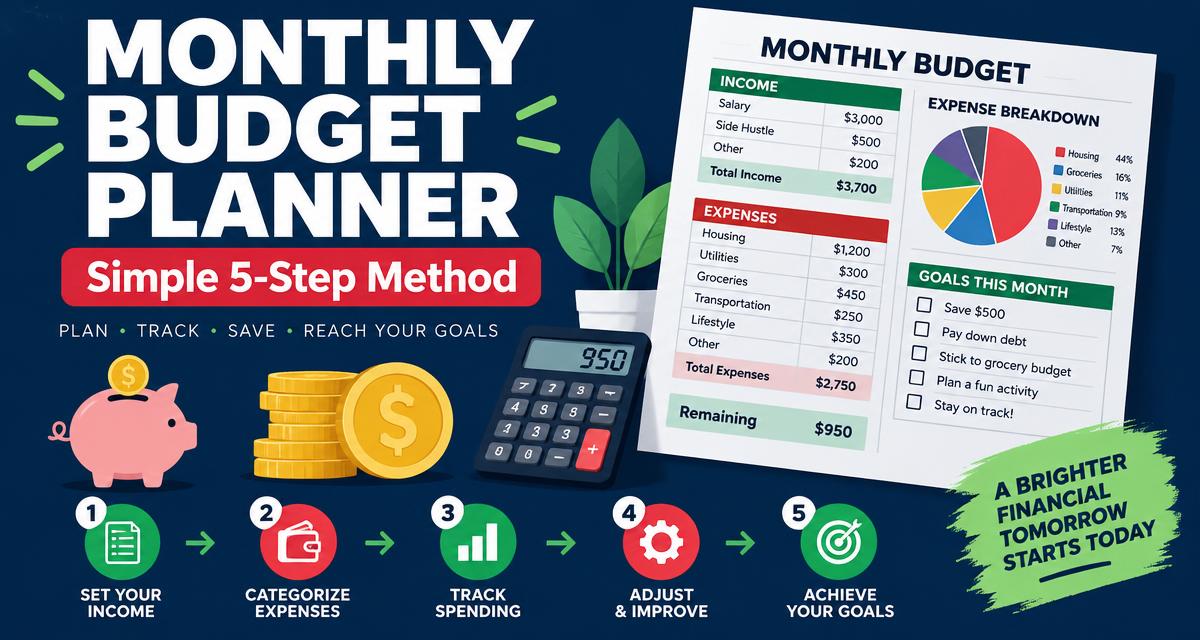
A budget is not about saying no to everything. It is a plan that tells your money where to go, so you stop wondering where it went.
This guide walks you through a monthly budget in five simple steps. All you need is a printable planner (or a sheet of paper) and 30 minutes.
Step 1: Write down your total monthly income
Add up everything you take home after tax: salary, side hustle, benefits, other income. If your income changes month to month, use your lowest recent month to stay safe.
Step 2: Sort your expenses into categories
- Needs: rent or mortgage, utilities, groceries, transport, insurance, minimum debt payments.
- Wants: eating out, subscriptions, shopping, entertainment.
- Savings & debt: emergency fund, extra debt payments, investing.
Step 3: Apply the 50/30/20 rule
A popular starting point: 50% of take-home pay for needs, 30% for wants, 20% for savings and debt payoff.
- Example on $3,700: Needs $1,850 · Wants $1,110 · Savings $740.
- If needs are above 50%, trim wants first before touching savings.
Step 4: Track every expense for 30 days
Write each purchase down the same day. Most people discover 2–3 'leaks' — unused subscriptions, delivery apps, impulse buys — in the first month alone.
Step 5: Review, adjust and set one money goal
- 1. Compare planned vs actual at month end.
- 2. Move money from categories you overspent on.
- 3. Set ONE goal for next month — e.g. 'Save $500' or 'Pay off one card'.
Tips to stick to your budget
- Automate savings on payday.
- Use cash or a separate card for wants.
- Plan for irregular costs (birthdays, car repairs) with a small monthly 'sinking fund'.
Sources and further context
Your next useful read
Frequently asked questions
What is the easiest budget method for beginners?
The 50/30/20 rule is the simplest: half for needs, 30% for wants, 20% for savings and debt. Adjust the numbers to your situation.
Is a printable budget planner better than an app?
For many people, yes — writing things down by hand makes spending feel more real and keeps you engaged. Use whichever you will actually keep using.
How much should I have in an emergency fund?
A common guideline is three to six months of essential expenses. Start with a smaller goal like $500–$1,000.
How often should I review my budget?
A quick weekly check and a full monthly review work well for most households.
Track every money milestone
The Money Milestone Cheat Chart is a printable planner for budgets, savings goals and debt payoff on one page.