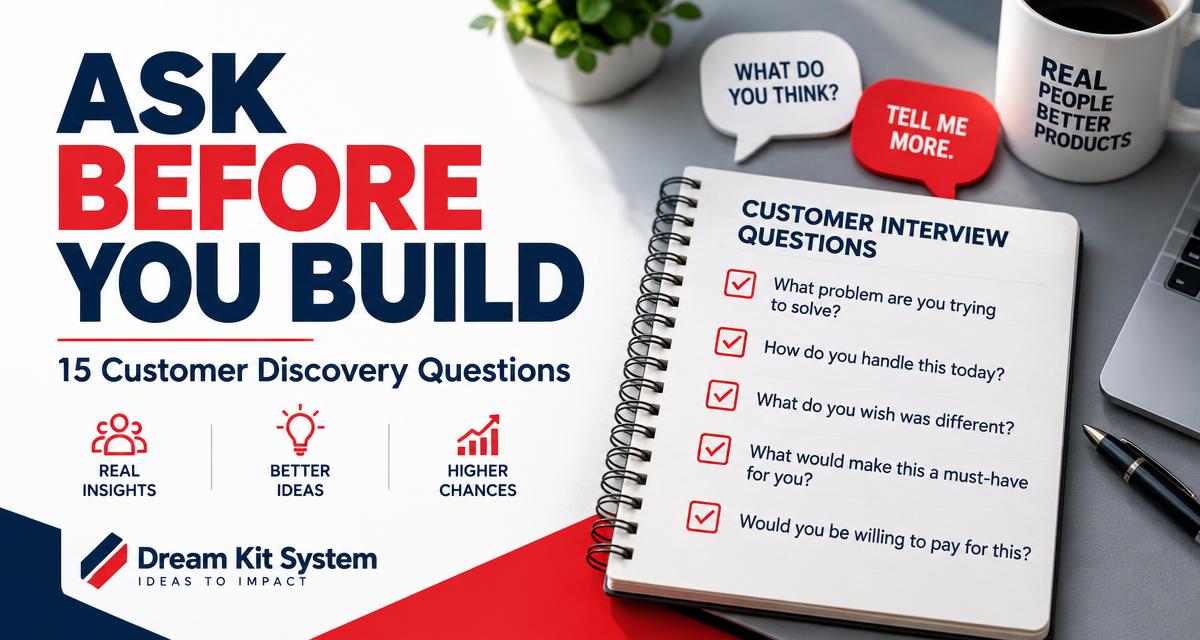
Customer discovery questions help you understand a potential buyer's real problem, current workaround and purchasing process before you build a solution. Ask about something that actually happened, not whether someone likes your idea. A compliment is easy to give; a specific story about a costly problem is more useful evidence.
This guide gives you 15 questions you can copy into your notes, a short interview structure and a way to compare answers. The examples apply to a physical invention, a printable planner or a digital guide. They are illustrative exercises, not claims about customer results.
What should you ask in a customer discovery interview?
Start with a recent situation, explore what the person did, and only then discuss how a purchase would work. Your first job is to understand the problem rather than pitch your product. The SBA recommends examining demand, market size, existing alternatives and pricing when researching a market.
Recruit people who resemble your intended customer. A planner for shift workers needs input from shift workers, not just friends who enjoy stationery. Explain that you are researching a problem, ask permission to take notes and avoid collecting personal information you do not need.
15 customer discovery questions to copy
Question 15 is a request, not permission to add someone to a mailing list. Explain the specific follow-up, respect a refusal and keep any agreement in your notes. If a question sounds unnatural, adapt the wording without changing its purpose.
- 1. Tell me about the last time you ran into this problem.
- 2. What were you trying to get done?
- 3. What triggered the difficulty?
- 4. How often has this happened recently?
- 5. Which part was hardest or most frustrating?
- 6. What did you do to handle it?
- 7. Which tools, products or services did you try?
- 8. What worked well about that approach?
- 9. What still did not work?
- 10. How much time did the workaround take?
- 11. Have you spent money to solve it? What did you buy?
- 12. What made you choose that option?
- 13. Who else is involved in choosing or paying for a solution?
- 14. What would you need to check before switching to something new?
- 15. May I contact you separately if I have a relevant test for this problem?
A short interview script that does not sound like a sales pitch
Open with: 'I am researching how people manage this task. I am not selling anything in this conversation. Could you walk me through the last time you did it?' Ask one question at a time, pause and let the person describe the situation in their own words.
For a meal-planning printable, ask what happened last week when dinner planning went wrong. Did the person use an app, a notebook or no plan? Was the difficulty deciding meals, remembering ingredients or finding time? Those are different problems and may need different products.
Save your concept until the end. If you show a draft, watch what the person understands and what they try to do. Do not explain every feature first; that hides confusion you need to discover.
Turn interviews into an evidence worksheet
Keep observations separate from interpretations. 'Uses a notebook every Sunday' is an observation. 'Will buy my planner' is an assumption. Compare repeated patterns across interviews while preserving disagreements. A small convenience sample is not a market-size estimate.
- Customer segment: who was interviewed and why they fit.
- Recent example: the task, situation and date range described.
- Existing solution: what they use and what they have already paid for.
- Cost of the problem: time, money or repeated inconvenience, in their words.
- Purchase process: who decides, who pays and what must be checked.
- Next experiment: the smallest test that could challenge your assumption.
Common interview mistakes that make weak ideas look strong
Avoid 'Would you buy an app that saves time?' It gives the respondent a desirable answer without requiring evidence. Ask what they bought or tried last time instead. Do not use a long feature list, argue with objections or interview only supporters.
There is no magic number of interviews that proves demand. Set an initial research batch that fits your time, then investigate conflicting answers. Before spending heavily, look for behavior as well as words: using a test, requesting a specific improvement or paying for a clearly described pilot.
Your next step: schedule one useful conversation
Write down one customer group, one problem and the assumption you most need to test. Invite a suitable person, choose five questions from the list and leave room for follow-up questions. Afterward, write what surprised you before changing your product plan.
If you want a place to organize the work, the Product Launch Planner & Tracker includes a 90-day timeline, budget and channel tracker, and printable weekly action pages. It organizes tasks; it does not replace research or guarantee demand.
Sources and further context
Your next useful read
Frequently asked questions
What is customer discovery?
Customer discovery is research into who has a problem, how they handle it today and what would make a solution valuable. Interviews help test assumptions before product development.
What is the best first customer discovery question?
Ask the person to describe the last time they experienced the problem. A recent example usually gives more useful evidence than a hypothetical question about liking your idea.
How many customer interviews do I need?
There is no universal number. Start with a manageable batch from your target segment, look for patterns and disagreements, then run further interviews and behavior-based tests before major spending.
Can I use these questions for digital products?
Yes. Ask how people currently complete the task, what resources they use and what they have paid for. Use the answers to test whether a guide, template or another format is appropriate.
Put your customer research on a launch timeline
Organize your next interviews, budget and weekly tasks with the Product Launch Planner & Tracker.