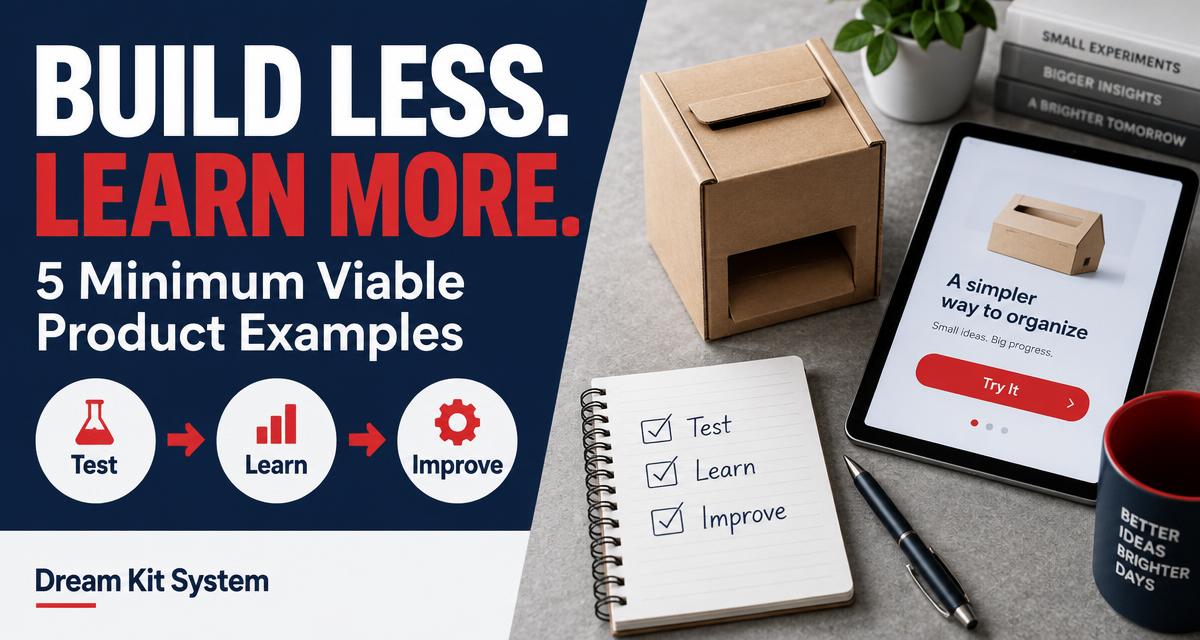
A minimum viable product, or MVP, is the smallest workable version of an offer that lets you learn from real users. It should deliver the core benefit to a defined customer, not simply display an unfinished collection of features. The Lean Startup approach emphasizes validated learning rather than building everything first.
The five examples below are hypothetical starting points for small businesses, not case studies or promises of commercial success. Each pairs a minimal offer with a question, a measurement and a reason to stop or change direction.
MVP vs prototype: what is the difference?
A prototype explores how something looks, feels or works. An MVP delivers a limited version of the benefit so you can learn from actual use. A cardboard shape may test a handle's size without being a usable product; a safe, functional hand-built version may let someone complete the intended task.
A landing page can test whether a message attracts interest, but it does not prove the product works or that visitors will pay. Treat it as a demand experiment rather than evidence of product satisfaction. This distinction prevents you from claiming validation too early.
Example 1: a single-purpose printable planner
Idea: a planning system for people working irregular shifts. Minimal offer: one weekly PDF that connects shift times, meals and a short shopping list. Leave out the full yearly calendar, decorative stickers and multiple themes.
Question: does the page make weekly planning easier for the intended user? Ask testers to use it for a normal week, then describe which parts they completed and which they ignored. Record repeat use and concrete suggestions, not just whether the design looks attractive.
Decision: revise confusing fields before adding pages. If the same users do not need a weekly planning tool, reconsider the problem rather than producing a larger bundle.
Example 2: a manual version of a future service
Idea: a personalized system for organizing a small business launch. Minimal offer: a clearly scoped planning session and a manually prepared action sheet for one customer segment. Be explicit about the manual service; do not imply that automated software exists.
Question: is the outcome valuable enough for the work required? Measure whether the customer completes the agreed next action, how much preparation and delivery time you spend, and which requests repeat. If you charge, show the scope and terms before payment.
Decision: automate repeated tasks only after you understand the service. If every delivery needs entirely different work, a standardized product may not yet fit.
Example 3: a safe small-batch physical product
Idea: a tabletop organizer for a particular workspace. Minimal offer: a small number of functional versions with the core storage and access features. Do not expand into multiple sizes and colors before learning whether the main design is useful.
Question: can people complete the intended task comfortably and repeatedly? Observe use, document failures and ask what existing product it replaces. Materials, safety, applicable rules and quality matter even in a small test; an MVP is not permission to expose users to hazards.
Decision: investigate repeated failure points before ordering a large production run. Initial enthusiasm is not a substitute for checking manufacturing feasibility and unit economics.
Example 4: a short guide solving one defined problem
Idea: a broad digital learning library. Minimal offer: an original guide that helps a specific reader complete one task, with one worked example and a checklist. Choose a task you can explain accurately rather than compressing an entire profession into a thin PDF.
Question: can the reader act on the material without more explanation? Ask a tester to complete the task and point out missing steps. Track requests for clarification and whether the checklist was used.
Decision: improve clarity and verify claims before expanding into related guides. A longer word count is not automatically more useful.
Example 5: one usable workflow in a digital tool
Idea: a complex productivity platform. Minimal offer: a single reliable workflow, such as entering a task, completing it and seeing a weekly summary. Test the whole flow with real input, including mistakes and empty states.
Question: does the workflow help enough that people return? Measure completion, repeat use and the points where users stop. A clickable screen mockup is useful earlier, but it cannot establish that a working tool performs reliably.
Decision: fix the main workflow before adding dashboards. If the problem is infrequent, a printable or simple document may be a better fit than a new app.
A simple MVP planning worksheet
Set your decision criteria before the test rather than rewriting them after disappointing results. Keep your first experiment small enough that you can afford to learn. The Launch Planner provides a timeline and tracking worksheets, not a guarantee that an MVP will succeed.
- Customer: who will use the first version?
- Core problem: what task is difficult today?
- Minimal benefit: what useful outcome can you deliver now?
- Assumption: what could make this idea fail?
- Evidence: which observable behavior will challenge that assumption?
- Guardrails: what safety, privacy and delivery conditions must hold?
- Review point: when will you continue, revise or stop?
Sources and further context
Your next useful read
Frequently asked questions
What is an example of a minimum viable product?
A single-purpose printable planner used by its intended customers is one example. It delivers the main benefit while leaving out features that are not needed for the first learning test.
Is a landing page an MVP?
A landing page is usually a demand experiment rather than a usable product. It can test interest in a message but cannot demonstrate that the promised solution works.
Does an MVP have to be an app?
No. It can be a physical item, a digital guide, a printable or a manually delivered service, provided it offers a useful core outcome and supports learning from actual users.
How much should I spend on an MVP?
There is no universal budget. Define the assumption to test, the minimum useful offer and necessary safety or compliance work, then set a spending limit you can afford before committing.
Plan the test before the full launch
Use the Product Launch Planner & Tracker to organize a 90-day timeline, budget and weekly action pages around your next experiment.