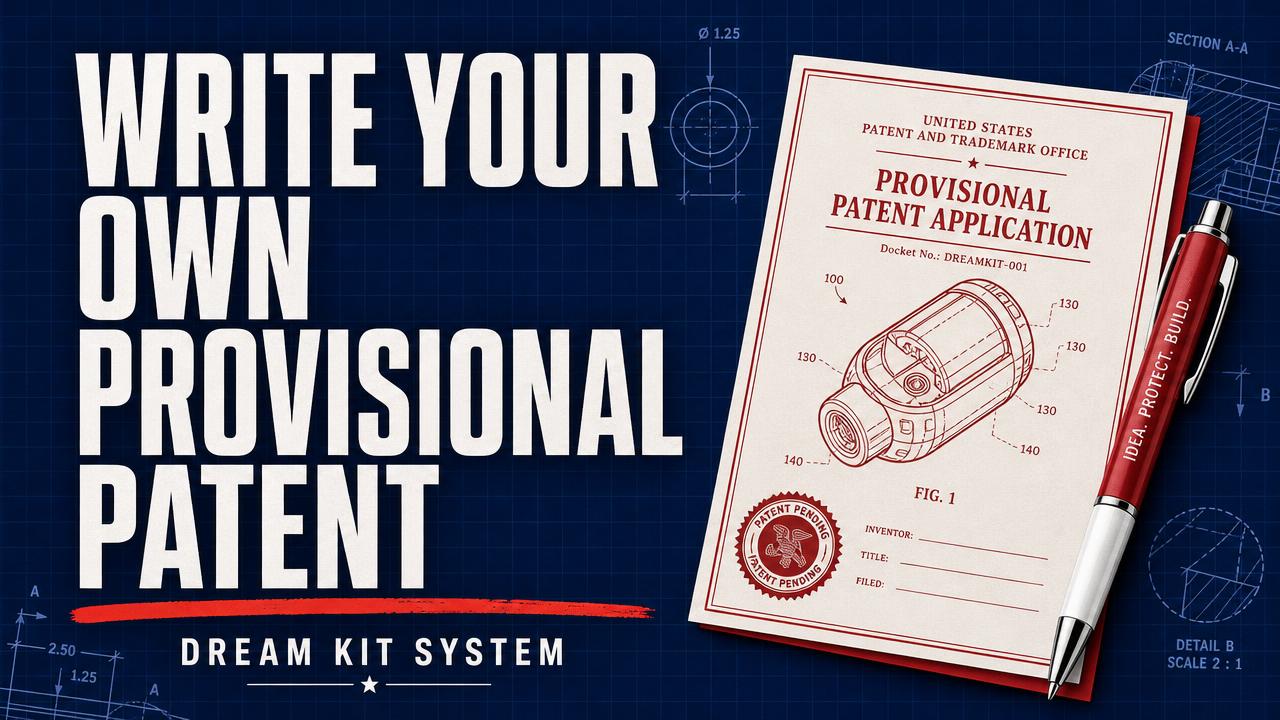
A provisional patent application is not a legal maze. It is a clear written description of your invention plus drawings, filed with the USPTO for a micro-entity fee of about $60. I wrote mine myself, and it held up all the way to a national distribution deal.
The single job of this document is to prove that on a specific date, you were in possession of this invention and could describe it well enough for someone in your field to build it. Write for that reader, not for a lawyer.
What a provisional actually buys you
- A filing date you can claim for the next twelve months.
- The legal right to say 'patent pending' on your product, sell sheet and website.
- Time to test the market, quote factories and talk to buyers before spending on a full utility patent.
- Nothing is examined — but nothing is protected beyond what you actually described, so detail matters.
Section 1 — Title of the invention
Plain and functional, not a brand name. 'Teetering ring toss target apparatus' beats 'Teeter Toss'. Six to fifteen words describing the thing itself.
Section 2 — Field and background
One short paragraph naming the field, then two or three paragraphs on the problem that exists today. Describe what current products do badly. Do not attack any competitor by name and do not overstate — you are setting up why your solution matters.
Section 3 — Summary of the invention
Three to six paragraphs explaining the invention in ordinary language: what it is, what it does, what the main parts are and what advantage it delivers. Use 'in one embodiment' when you describe a specific version, so you are not locked into it.
Section 4 — Drawings
- Black and white line drawings, one view per page: perspective, side, top, exploded and any moving state.
- Number every part (100, 110, 120…) and keep those numbers identical in the text.
- Hand drawings are legally acceptable if they are clear — a ruler and a fine black pen are enough.
- Add a short figure list: 'FIG. 1 is a perspective view of the apparatus.'
Section 5 — Detailed description (the part that matters)
Walk through every part by number, what it is made of, how it connects, how it moves and what dimensions it may range across. Use ranges rather than fixed numbers — 'approximately 8 to 14 inches' protects far more ground than '11 inches'.
Then describe alternatives: other materials, other shapes, other ways to achieve the same function. Anything you fail to describe is something you cannot claim later.
Filing it with the USPTO
- Register for a free USPTO.gov account and use Patent Center to file electronically.
- Attach your specification PDF, drawings PDF, cover sheet (form SB/16) and micro-entity certification (SB/15A) if you qualify.
- Pay the fee — roughly $60 at micro-entity rate — and save the confirmation and application number.
- From that moment you are patent pending, for twelve months, with no extensions.
Common mistakes that make a provisional worthless
- Describing only one version of the invention.
- Vague functional language with no structure ('a mechanism that holds the ring').
- Drawings whose part numbers do not match the text.
- Adding new features to the product after filing and never filing an updated provisional.
- Letting the twelve months lapse without filing the utility application.
Frequently asked questions
Do I need a lawyer to write a provisional patent?
No. Provisionals are not examined, and you may file your own. Many inventors write the provisional themselves and hire an attorney later for the utility application, when claim language really matters.
How much does a provisional patent cost in 2026?
About $60 for a micro-entity, $130 for a small entity. The cost is the filing fee — the writing is your time.
How long should a provisional patent application be?
As long as it takes to fully describe the invention. Ten to twenty-five pages with drawings is typical. Short and vague is the only real danger.
Can I change my invention after filing a provisional?
You cannot add new material to an existing provisional. If the design changes meaningfully, file a second provisional covering the new version — they are cheap enough to file more than once.
Turn the reading into action.
Explore practical tools for developing your concept, launching a product and building a business from the ground up.