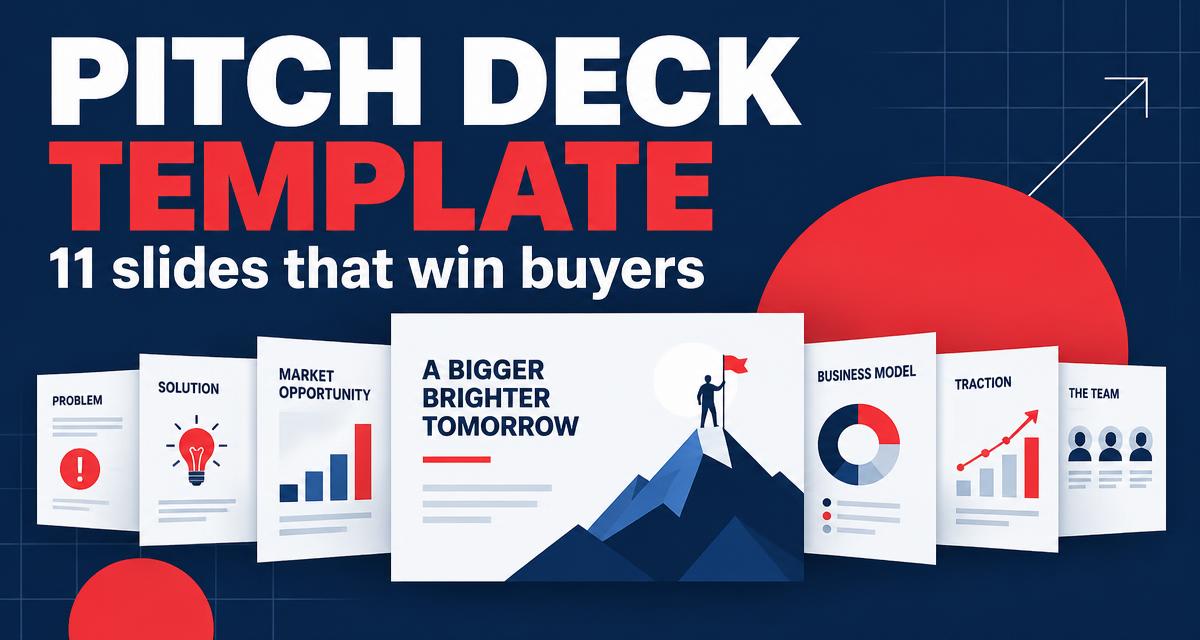
A pitch deck for a product is not a startup fundraising deck. Buyers, licensees and distributors want to know what it is, who buys it, what it costs to make and why now — in about six minutes.
Eleven slides is enough. Anything longer usually means the idea has not been narrowed down yet.
The 11 slides
- 1. Title — product name, a clean hero image and one line saying what it is.
- 2. Problem — the specific frustration your product removes, stated in the customer's words.
- 3. Solution — the product, shown rather than described.
- 4. How it works — three steps or a short demonstration image sequence.
- 5. Market — who buys it, where they buy it and a sourced size estimate.
- 6. Competition — an honest comparison table and the one thing you do differently.
- 7. Traction — prototypes built, testing done, pre-orders, pilot customers, press or awards.
- 8. Business model — unit cost, wholesale price, suggested retail price and margin.
- 9. Status and IP — patent pending or granted, tooling readiness and production plan.
- 10. The ask — licensing, purchase order, distribution or investment, stated plainly.
- 11. Contact — name, email, phone and website on one uncluttered slide.
What to cut
- Long origin stories — one sentence is plenty.
- Unsourced market numbers that any buyer can disprove in a search.
- Five-year revenue projections for an unlaunched product.
- Dense paragraphs; a slide is a headline plus an image.
- Confidential drawings or full engineering detail before an NDA is signed.
Design rules that make a deck look professional
- One idea per slide with a headline that states the conclusion.
- Real product photography or a clean render, never clip art.
- Two fonts and three colours across the whole deck.
- Readable type — nothing smaller than 18pt, as many buyers review on a phone.
- Export to PDF so the layout survives every device.
Deck or sell sheet?
A sell sheet is one page you email to open a door. A pitch deck is what you present once someone is interested. Most product conversations need both, and the two should share the same photography, claims and pricing.
If you can only produce one first, produce the sell sheet — it gets more replies.
Before you send it
- Read it aloud to check every slide can be explained in under 40 seconds.
- Have someone outside your category read it and tell you what the product does.
- Check every number appears identically on the deck, the sell sheet and your website.
- Name the file clearly, for example Product-Name-Pitch-2026.pdf.
- Keep the file under 10MB so it does not bounce from corporate inboxes.
Frequently asked questions
How many slides should a product pitch deck have?
Around eleven. That is enough to cover problem, product, market, model, status and the ask without losing the room.
What is the difference between a sell sheet and a pitch deck?
A sell sheet is a single page used to start a conversation by email. A pitch deck is a short presentation used once a buyer or licensee is engaged.
Should I include pricing in a pitch deck?
Yes. Include unit cost, wholesale price and suggested retail price. Buyers and licensees evaluate margin first, and omitting it usually delays the discussion.
Do I need a patent before pitching a product?
Not always, but a filed application gives you a date and lets you talk more openly. Where no filing exists, limit disclosure and use an NDA.
Start from a proven deck structure
The Pitch Deck & Sell Sheet Template Kit gives you both documents laid out and ready to fill in with your product, pricing and photography.